SPECIAL CONTENTS
Hydrogen is the lightest gas in the universe, formed when two hydrogen atoms bond together, represented by the chemical formula H₂.
Since hydrogen (H₂) contains no carbon (C), burning it does not produce carbon dioxide (CO₂).
For this reason, hydrogen is attracting attention as a next-generation energy source that contributes to reducing CO₂ emissions.
Hydrogen contains no carbon (C), so burning hydrogen does not produce CO₂.
For this reason, hydrogen is attracting attention as a next-generation energy source that contributes to reducing CO₂ emissions.
As of 2022, Japan relies on fossil fuels such as oil, coal, and natural gas (LNG) for more than 80% of its primary energy,
importing most of these from overseas. On the other hand, hydrogen can be produced from various sources, including water,
which are available domestically.
This capability contributes to improving the country’s energy self-sufficiency.
Hydrogen can be stored in various forms for extended periods. By storing hydrogen, it can be utilized as an energy source during power shortages or emergencies such as disasters.
Fuel cells using hydrogen can supply not only electrical energy but also thermal energy. Besides its expected use for high-temperature heat
in industrial applications, hydrogen combustion heat is also attracting attention for hydrogen power generation, where turbines or pistons are driven by the heat to generate electricity.
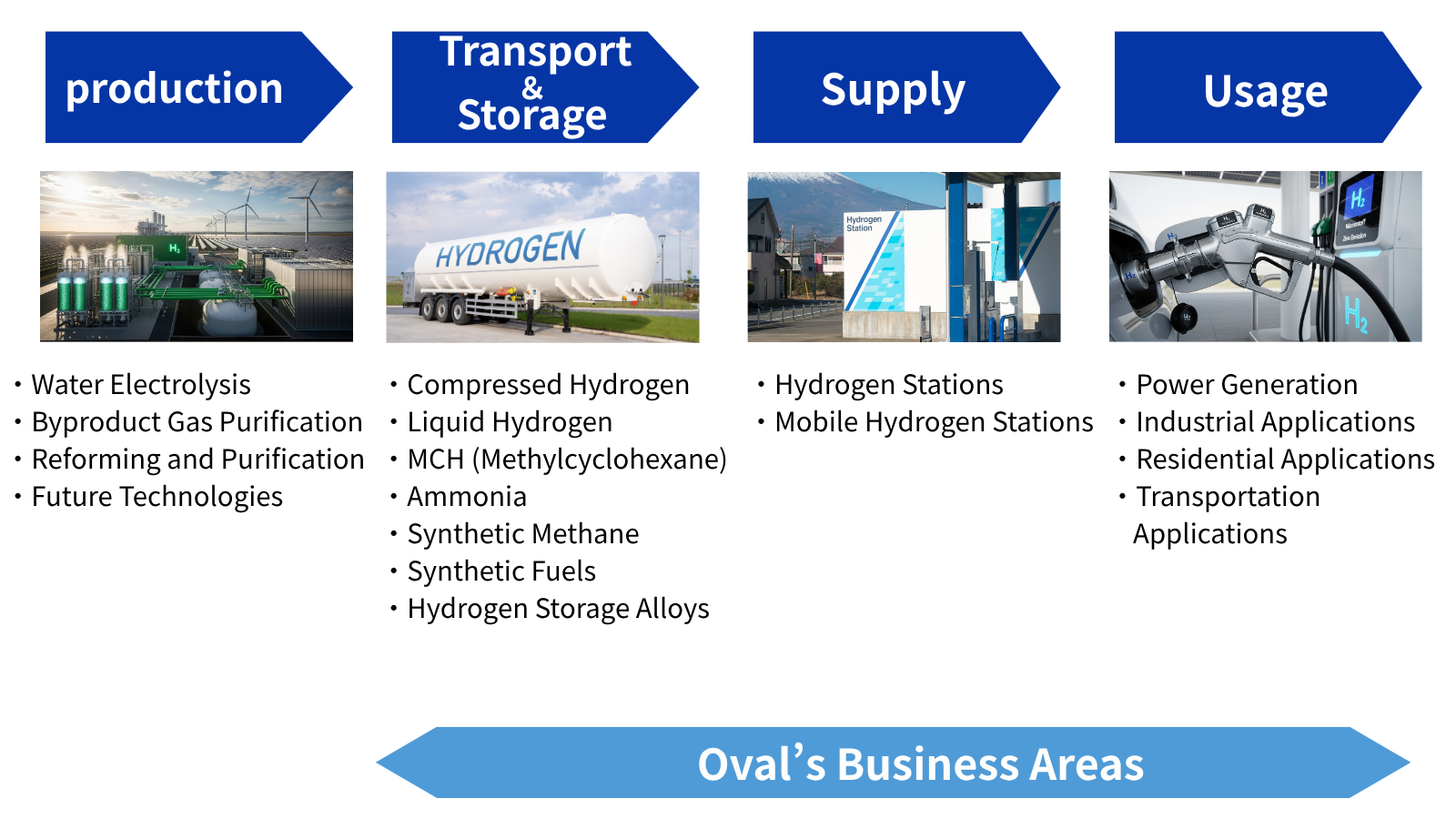
To utilize hydrogen as an energy source, it is essential to build a hydrogen supply chain consisting of “production,” “storage and transportation,” and “usage.” Our company contributes to realizing a hydrogen society by focusing on the areas of “storage and transportation” and “usage.”

 ご購入
ご購入