Flowmeters and System Solutions
Flowmeters and System solution.
Flowmeters and System Solutions
Flowmeters and System solution.
CALIBRATION
 From these two definitions
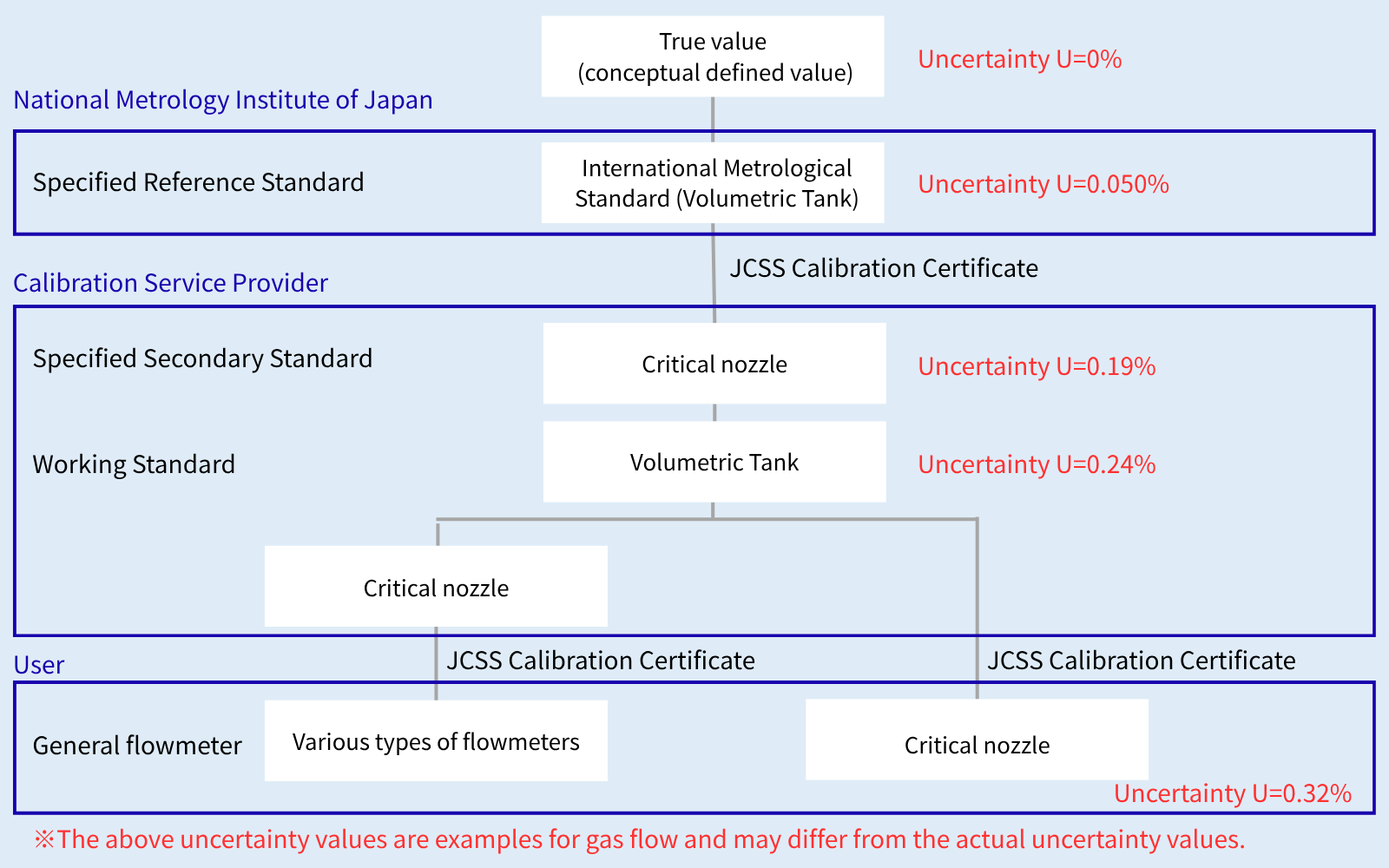
If a calibration certificate does not include the indication of "uncertainty," it lacks the basis for traceability. Therefore, according to the formal definition, calibration without a clear "uncertainty" cannot be said to ensure traceability.
※Our company is registered under the Calibration Certification System based on the Measurement Act (JCSS). The JCSS calibration certificates issued by our company serve as complete proof of traceability.
Definition of uncertainty: It indicates the range within which the "true value" is expected to lie, representing the extent of variability around a measured value.
Definition of True Value: A conceptual value that cannot actually be obtained, but because it is a conceptual value, it serves as a universally accepted reference value.
I think this alone may not be very clear, so let’s deepen our understanding with a concrete example.
A quartz watch with a monthly variation of ±15 seconds and a mechanical pendulum clock that loses or gains 10 seconds per day.
The traditional concept of "accuracy" simply considered the performance of the clocks as:(quartz watch = high accuracy) > (pendulum clock = low accuracy).
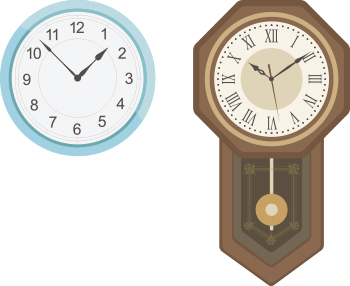
From now on, we will consider the conditions of "calibration uncertainty." For example, if the management system is such that the pendulum clock is adjusted every day at noon using the time signal because it tends to drift easily, while the quartz watch, which drifts less, is adjusted only once every three months using the time signal, the maximum error for the pendulum clock will be ±10 seconds, whereas for the quartz watch it will be ±45 seconds.
In terms of indicated uncertainty, the pendulum clock’s display shows better accuracy than the quartz watch’s display, so the accuracy evaluation based on uncertainty is reversed.
Uncertainty indicates the range within which the true value is believed to exist with a certain probability.For example, if the expanded uncertainty for a calibration value is 0.1% (k=2), it is estimated that the value considered as the true value lies within the range of the calibration value ±0.1% with approximately 95% probability.When performing any form of management using calibration values (for example, the device error of a flowmeter), taking into account the uncertainty associated with the calibration value allows you to establish more reliable management reference values.
It is usually stated as "Expanded Uncertainty" as follows.
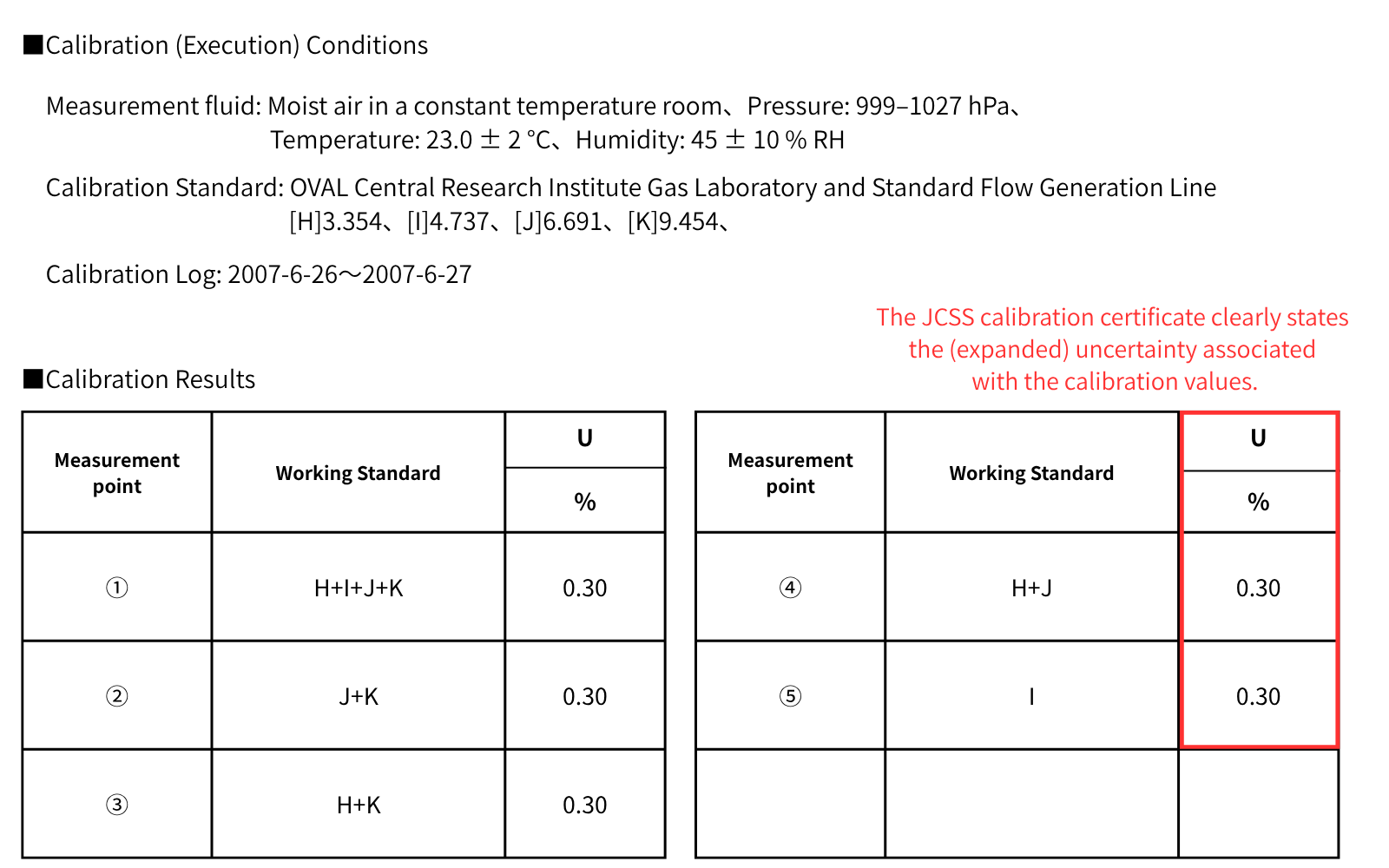
※The uncertainty value stated on the calibration certificate is added to the calibration results. It is not the uncertainty of the flowmeter itself.
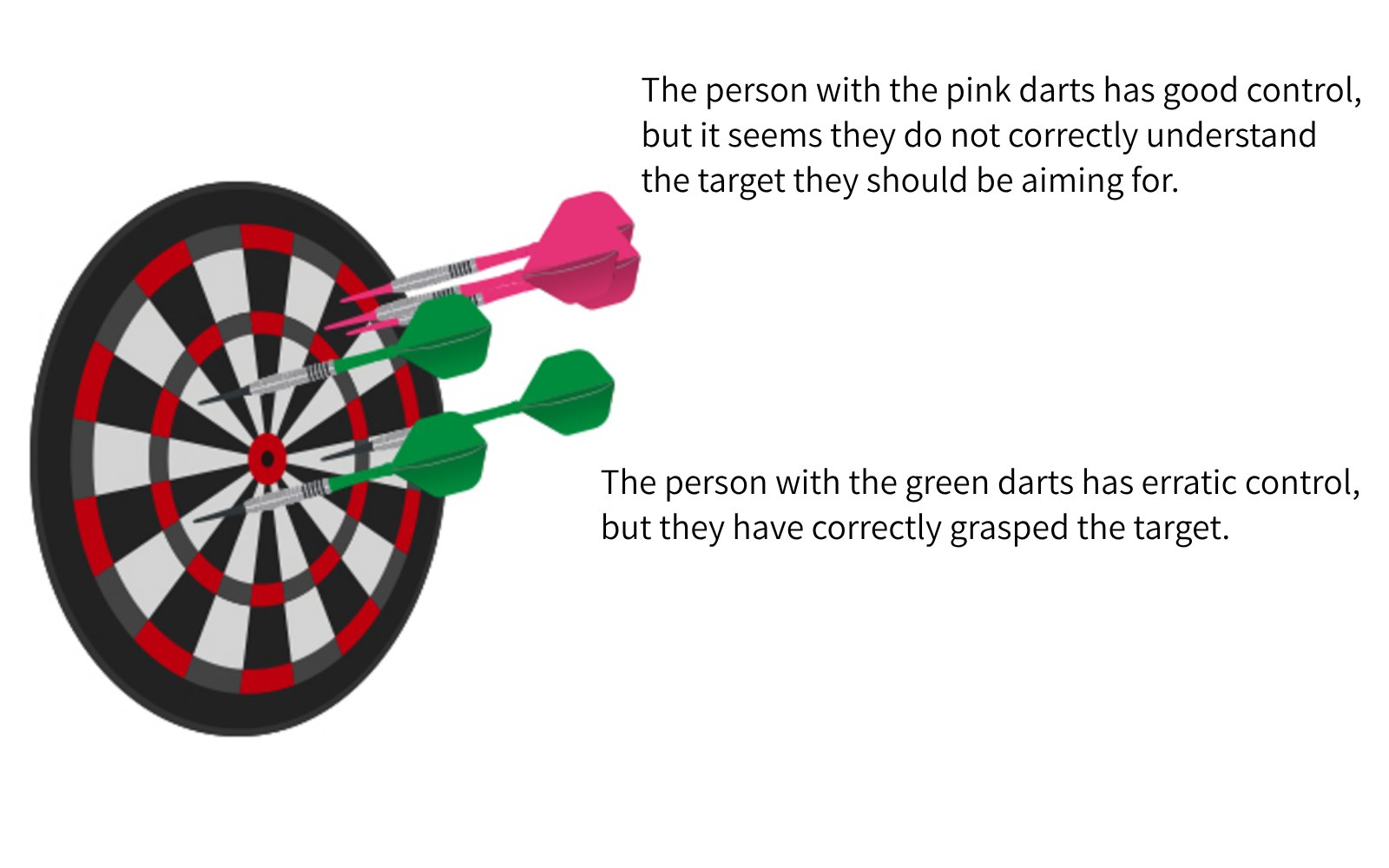
If we compare these dart throwers to flowmeters, the previous evaluation results showed that the accuracy of the (superior) pink flowmeter was considered better than that of the (inferior) green flowmeter, which presented practical issues.
When compared based on uncertainty, the (superior) green flowmeter’s uncertainty versus the (inferior) pink flowmeter’s uncertainty presents a realistic contrast regarding which one is closer to the true value.